
How Huru scores your interview answers
Every practice answer on Huru gets a score out of 100, and every live interview gets an overall score and a verdict. This page explains what goes into each number, what Huru doesn’t measure, and how to use your scores to improve.

The short answer
Each answer is scored out of 100 on five criteria: relevance, structure, specificity, impact and ownership, and articulation. After a live interview with Huru’s AI interviewer, you also get an overall score out of 100 that weighs the quality of your answers at 70% and your conversation skills at 30%, a verdict from Keep practicing to Outstanding, measures of how you spoke, and, if you chose video, feedback on how you came across on camera. Huru never analyzes your voice tone, pitch or accent and doesn’t read emotions. Its scores are coaching signals, not hiring decisions.
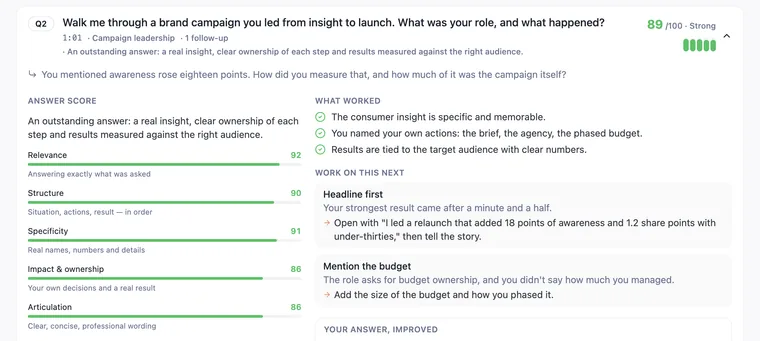
Every answer: five criteria, one score out of 100
Live or question by question, each answer is scored on the same five criteria, so you can compare one take with the next.
| Criterion | What it checks | What helps |
|---|---|---|
| Relevance | Whether you answered exactly what was asked. | Answer the question in your first sentence, then support it. Stay on the question even when you have a better story for a different one. |
| Structure | Whether the answer moves from the situation to your actions to the result, in that order. | Set the scene in a sentence or two, spend most of the answer on what you did, and finish with the result. The STAR method is the usual shape. |
| Specificity | Real names, numbers and details, rather than general statements. | Say which project, how many people, what changed and by how much. “We improved onboarding” scores lower than “I cut onboarding from ten days to four”. |
| Impact and ownership | Your own decisions, and a result that came from them. | Say “I” for what you did and “we” for what the team did, explain one decision you made, and name the outcome. |
| Articulation | Clear, concise, professional wording. | Short sentences, no long warm-up, and an ending that lands rather than trails off. |
What comes back with each answer
- What worked in the answer
- What to work on next, with why it matters and how to fix it
- “Your answer, improved”: your own story rewritten into a stronger version
- Step-by-step guidance on how to structure that answer
- The transcript of what you said, with a link to that moment in the recording
Example (a fictional candidate)
An answer scores 88/100:
- It defines the problem
- It shows personal ownership
- It uses customer evidence
- It puts a number on the result: an 18% improvement in activation
Next: Explain the alternative that was rejected, and the criteria behind the decision.
Across her practice interviews, the same candidate’s score moves from 64 to 84.
After a live interview: the overall score and a verdict
A live interview is a conversation with an AI interviewer who follows up on what you say. A few minutes after it ends, the debrief scores the whole interview out of 100.
Seventy percent of the score is how good your answers were. The other thirty is four conversation skills:
- Depth under follow-up. When the interviewer asks “how did you measure that?” or “what would you do differently?”, does your answer get more concrete, or repeat itself?
- Conciseness and pacing. Whether your answers are the right length for the question, and move at a pace the listener can follow.
- Composure under pressure. How you handle a challenging follow-up or push-back, which the Demanding pressure level brings on more often.
- Engagement and close. How you engage with the interviewer and bring the conversation to a close, for example with questions of your own at the end.
A skill that never came up (for example, no challenge was raised) isn’t graded, so it can’t count against you.
The verdict and the scorecard
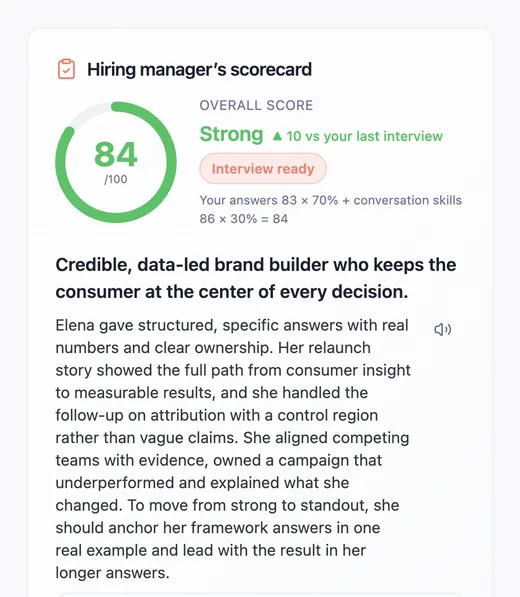
Every live interview ends with one of four verdicts:
- Keep practicing
- Almost there
- Interview ready
- Outstanding
The hiring manager’s scorecard beside it gives:
- A one-line headline about you as a candidate
- A summary, which you can also listen to
- The reasoning behind the verdict
- The top three things to work on next
- Your progress since your last interview
How you spoke, in numbers
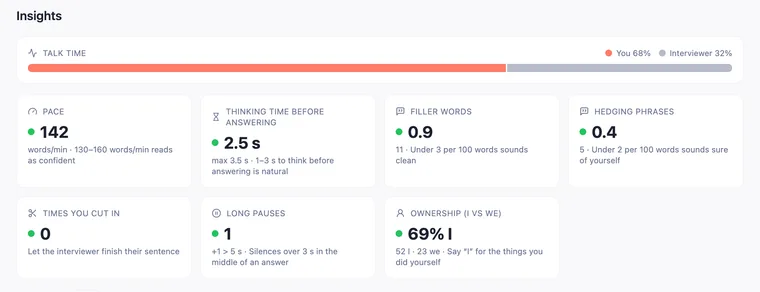
The debrief of a live interview also measures your delivery. These are counts and timings, with the ranges Huru treats as natural where it gives one.
| Talk time | How much of the conversation was you, and how much the interviewer |
|---|---|
| Pace | Words per minute; Huru treats 130 to 160 as a confident pace |
| Thinking time | The pause before you start answering; 1 to 3 seconds is natural |
| Filler words | Per 100 words |
| Hedging | Phrases such as “I think maybe…” |
| Cutting in | How often you interrupted the interviewer |
| Long pauses | Silences in the middle of an answer |
| Ownership | How often you said “I” rather than “we” |
What you said, across the whole interview
Story structure
A STAR table shows, answer by answer, whether you covered the situation, task, action and result.
Job description coverage
How many of the job’s key requirements your answers addressed, and which ones you missed.
Consistency and credibility
Whether your numbers and claims held up across the whole interview.
Key moments
Standout moments with the exact quote and why they worked; moments to rework, each with a stronger version; and watch-outs such as vague answers or overclaiming.
On camera, if you choose video
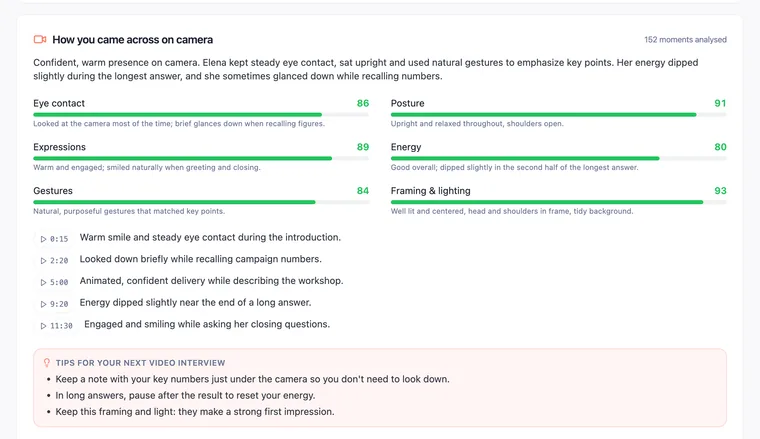
Live interviews can be video or audio only. On video, the debrief adds six aspects of how you came across, each scored with a sentence of explanation, a timeline of moments you can click to watch, and tips for your next video interview.
- Eye contact
- Posture
- Expressions
- Energy
- Gestures
- Framing and lighting
Audio only? You get the same scores and coaching, without this part. More on setting up for video: video interview practice.
What Huru never measures
Knowing what a score leaves out matters as much as knowing what it includes.
- Your voice tone, pitch or accent. Pace and pauses are timed; how your voice sounds is not judged.
- Your emotions, personality or who you are. It assesses the interview you just gave.
- Anything while you are answering. Feedback arrives after the interview; Huru doesn’t coach you mid-answer.
- Your chances with a particular employer. Scores are coaching signals, not hiring decisions or guarantees of a job, and employers’ own tools score differently.
How employers’ AI interview tools score candidates is a different question: see how AI interview scoring works and what to expect in an AI interview.
How to use your scores
A score is useful when it tells you what to do next. Four habits that make Huru’s scores move.
Fix one thing, then answer again
Take the top item from “what to work on next”, practice the same question, and compare. One change per take is how scores move.
Watch the trend, not one number
A single score depends on the question and the day. Your average on each criterion, and the line on your progress chart, are the better guide.
Practice the follow-ups
If depth under follow-up is your weakest conversation skill, choose Sofia, who loves concrete details, or the Demanding pressure level.
Rehearse the real format
Interviewing by video? Practice on video, so you also get the on-camera feedback. Phone screen? Audio only gives you the same scores and coaching without a camera.
Huru scores: questions
How does Huru score interview answers?
How is the overall interview score calculated?
What do the verdicts mean?
Does Huru analyze my voice or my face?
Do I get the same scores in question-by-question practice?
Can I be scored in another language?
Is a Huru score the same as an employer’s AI interview score?
About this page
Written from Huru’s product documentation and checked against the app on . The example candidate is fictional, and the screens show the app’s demo profile. When the scoring changes, this page changes with it.
Who makes Huru: About Huru. The facts in one place: facts and press kit.
See your own scores tonight
Talk with a live AI interviewer or answer question by question, then read your debrief: every answer scored, with the fix and a stronger version. Huru is free for everyone.