
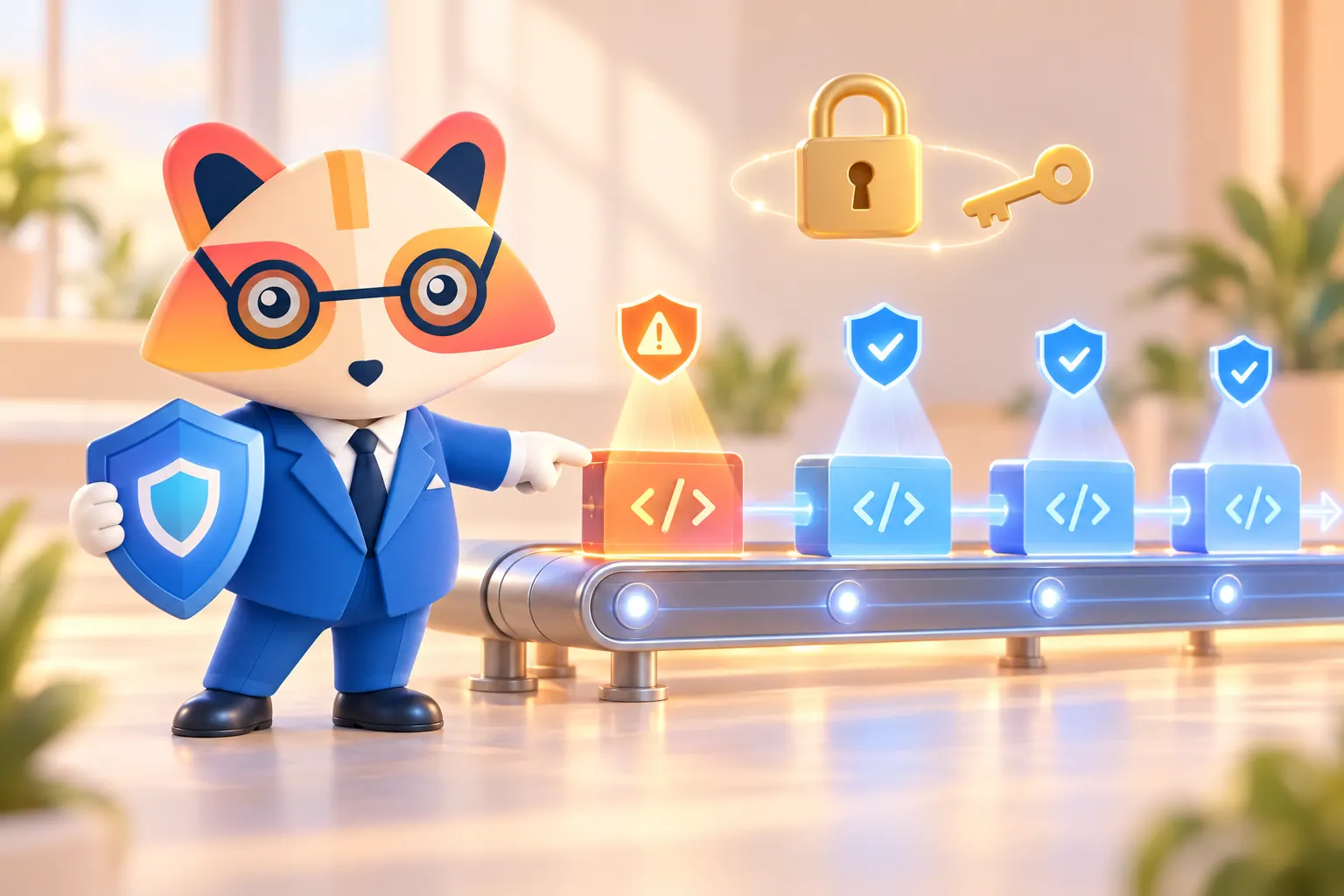
The short answer: DevSecOps interviews test whether you can build security into the delivery pipeline without slowing teams down. Expect questions on shift-left (finding issues early), security checks at each stage (SAST, SCA, secrets scanning, IaC and container scanning, DAST), software supply chain security (SBOMs, artifact signing, SLSA), secrets management, Kubernetes and cloud security, frameworks such as NIST’s Secure Software Development Framework, and scenarios like a leaked key or a critical vulnerability in a dependency. Interviewers look for practical judgment: which findings block a build, and how you keep developers on side.
Core concepts
“What is DevSecOps, and what does shift-left mean?”
DevSecOps makes security a shared responsibility built into development and operations rather than a final gate. Shift-left means moving security checks earlier (into design, coding and pull requests) where issues are cheaper and faster to fix.
“How do you add security to a CI/CD pipeline?”
| Stage | Checks |
|---|---|
| Design | Threat modeling for new features and architecture changes |
| Code / pull request | SAST (static analysis), secrets scanning, linting, code review |
| Dependencies | SCA (software composition analysis) for known vulnerabilities and licenses |
| Build | Container image scanning, IaC scanning (Terraform, Kubernetes manifests), SBOM generation, artifact signing |
| Test / staging | DAST (dynamic testing of the running app), API security testing |
| Deploy / runtime | Admission policies, runtime monitoring, cloud posture checks, logging and alerting |
“Which findings should break the build?”
Only high-confidence, high-severity issues with a clear fix (for example, a leaked secret or a critical vulnerability with a patched version). Lower-severity findings go to a backlog with service-level targets. Breaking builds on noisy findings trains developers to ignore security.
Supply chain security questions
- “What is an SBOM?” A software bill of materials: a list of the components and dependencies in a piece of software, so you can find affected systems quickly when a new vulnerability appears.
- “What is SLSA?” The SLSA project describes itself as a set of incrementally adoptable guidelines for software supply chain security, established by industry consensus, giving producers a way to secure their builds and consumers a way to decide whether to trust a package. Levels focus on build provenance and tamper resistance.
- “How do you protect against malicious or compromised dependencies?” Pin versions and use lock files, use private registries or proxies, verify signatures and provenance where available, scan dependencies continuously, and review new dependencies before adoption. Software supply chain failures appear as A03 in the OWASP Top 10:2025.
- “What is NIST’s SSDF?” The Secure Software Development Framework (NIST SP 800-218), a set of secure development practices organizations can map their processes to; NIST has also published SP 800-218A with practices specific to developing generative AI models.
Secrets management questions
- “How should applications get secrets?” From a secrets manager or the cloud provider’s secret store at runtime, with short-lived credentials where possible (for example, workload identity instead of long-lived keys), never hard-coded or committed.
- “A developer committed an API key to Git. What do you do?” Revoke and rotate the key immediately (removing it from history isn’t enough), check logs for misuse, remove it from the repository history, and add pre-commit and CI secrets scanning so it doesn’t happen again.
Kubernetes and cloud security questions
- “How do you secure a Kubernetes cluster?” Least-privilege RBAC, network policies, pod security standards (no privileged containers, non-root users), admission controllers to enforce policy, image scanning and signed images, secrets encryption, and audit logging.
- “How do you secure cloud infrastructure?” Infrastructure as code with policy checks before apply, least-privilege IAM, no public storage by default, encryption, centralized logging, and continuous posture monitoring.
Application security questions
Be ready to explain common risks from the OWASP Top 10:2025, such as broken access control (A01), security misconfiguration (A02) and injection (A05), and how pipeline checks and secure defaults prevent them. See our penetration tester interview questions.
Scenario questions
- “A critical vulnerability is announced in a library you use everywhere.” Use SBOMs and SCA to find affected services, prioritize internet-facing and sensitive systems, patch or apply mitigations, monitor for exploitation, and communicate status.
- “Developers say security scans slow them down.” Measure scan times, run fast checks on pull requests and deeper scans nightly, tune out false positives, provide fix guidance in the developer’s tools, and track mean time to remediate rather than raw finding counts.
- “How would you introduce DevSecOps in a team with no security tooling?” Start with the highest-value, lowest-friction steps (secrets scanning, dependency scanning, basic SAST), show quick wins, train security champions in each team, then expand.
Behavioral questions
- “Tell me about a security issue you found and how it was fixed.”
- “Tell me about a time you balanced security with delivery speed.”
- “How do you get developers to care about security?”
Related guides: DevOps engineer interview questions, security engineer interview questions, Kubernetes interview questions and Jenkins interview questions.
Frequently asked questions
What questions are asked in a DevSecOps interview?
What is the difference between SAST, DAST and SCA?
What should you do if a secret is committed to Git?
What is an SBOM?
Which security findings should block a build?
Sources
- National Institute of Standards and Technology, Secure Software Development Framework (SSDF). Read on 2 October 2026.
- SLSA, About SLSA. Read on 2 October 2026.
- OWASP, OWASP Top 10:2025. Read on 2 October 2026.