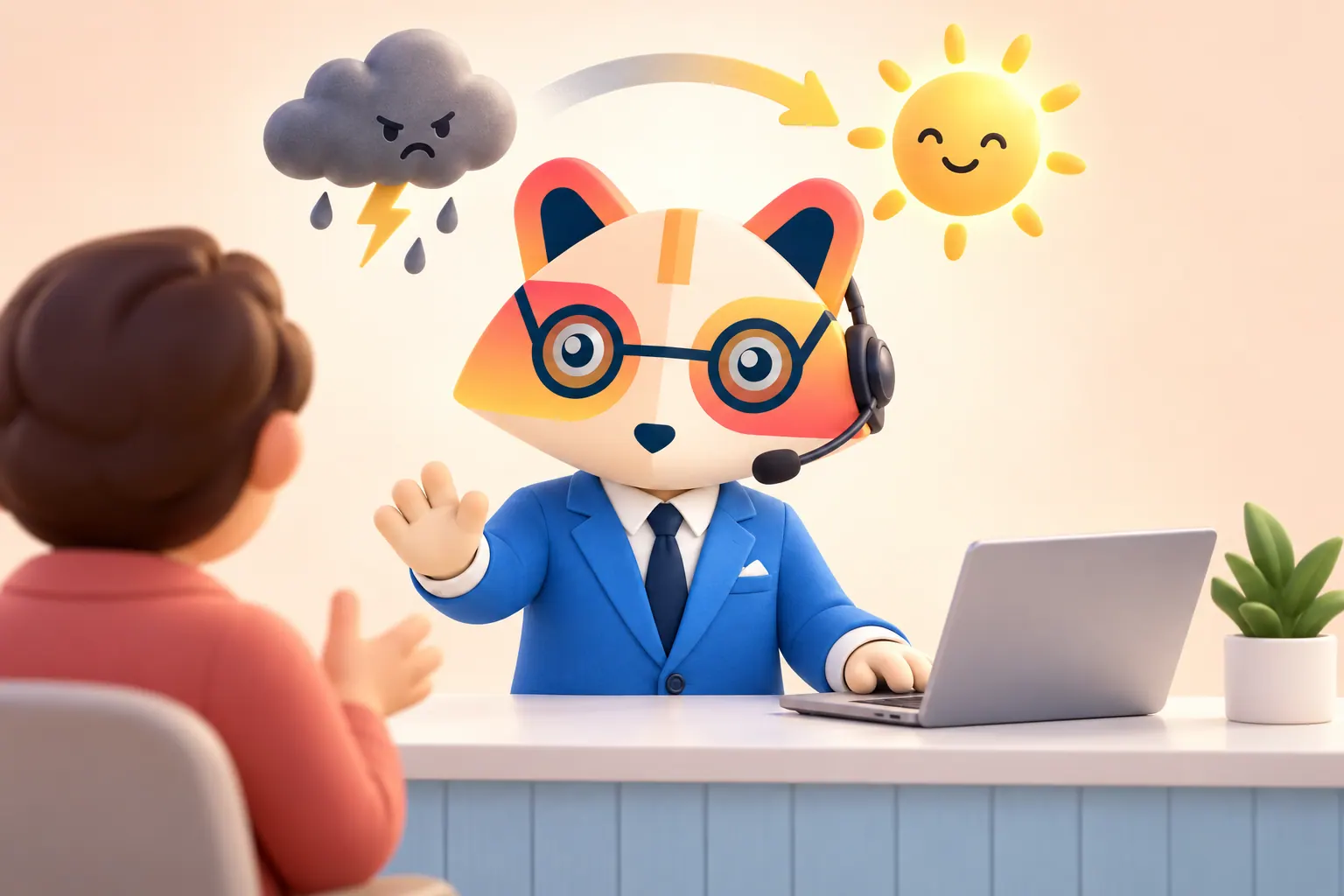
The short answer: pick a real situation where a customer or client was upset, and show that you stayed calm, listened to understand the real problem, took ownership of a fix within your authority, and followed up. End with the result: the customer’s reaction, the problem solved, and ideally something that changed to prevent it happening again. Never make the customer the villain of the story; the interviewer is listening for empathy and professionalism. Below is the structure, seven examples by job, how to answer the hypothetical “How would you handle an angry customer?”, and what to avoid.
What the interviewer is checking
- Composure: do you stay calm and professional under pressure?
- Empathy: do you understand why the customer is upset?
- Problem solving: do you fix the actual problem, not just the mood?
- Judgment: do you know when to bend a rule, when to escalate, and when to hold a boundary?
- Ownership: do you follow through?
How to structure your answer
Use the STAR method:
- Situation: who the customer was and why they were upset, in one or two sentences.
- Task: what you needed to achieve.
- Action: what you did, step by step: how you listened, what you said, what you fixed, who you involved. This is most of the answer.
- Result: how it ended, with a number if you have one, and what changed afterward.
Keep it to about two minutes.
Example answers
Examples are illustrations, not quotes from real candidates. Use your own experience.
Retail
“A customer came to the register furious because a jacket she’d bought for a trip had a broken zipper, and she was leaving the next morning. Our policy required the receipt for an exchange, which she didn’t have. I apologized, found the purchase in our system using her card, and checked stock: we had her size in another store. I called that store, had them hold it, and gave her directions. She came back the following week to thank me and bought two more items. I also told my manager, and we added a note to check zippers when restocking that brand.”
Call center or customer support
“A customer called for the third time about a double charge, and he was angry before I could say hello. I let him finish, then summarized what he’d told me so he knew I’d heard it. Instead of opening a new ticket, I looked at the previous two and saw the refund had been requested but never approved. I escalated it to my supervisor, stayed on the line while she approved it, and gave him the confirmation number. I called him back two days later to check the refund had arrived. Our survey after that call scored 5 out of 5, and I flagged the approval gap, which led to a fix in the refund queue.”
Restaurant or hospitality
“A table complained that their food had taken 40 minutes on a busy night. I apologized without making excuses, told them honestly that the kitchen was backed up, and checked on their order myself. When it came out I’d asked the manager to take dessert off their bill. They left a good tip and a positive online review mentioning how I handled it.”
Healthcare
“A patient’s daughter was angry that her mother had waited three hours in the emergency department. I listened, acknowledged how frightening the wait was, and explained where her mother was in the process without giving false promises. I checked with the charge nurse, got an updated time, and made sure someone updated them every 30 minutes. She thanked us before discharge and later wrote to the hospital praising the communication.”
Client-facing professional (agency, consulting, account management)
“A client was unhappy with a campaign we’d launched and threatened to end the contract. I set up a call the same day, asked what they had expected, and realized we had optimized for clicks while they cared about qualified leads, a gap in our brief. I owned that, proposed a two-week change in targeting and reporting, and sent them weekly updates. Qualified leads doubled over the next month and they renewed for another year. We now confirm success metrics in writing at kickoff.”
IT help desk
“A senior manager was angry that his laptop kept disconnecting before a board presentation. I stayed calm, set him up with a loaner laptop immediately so he could present, and then investigated. It was a failing network card. I replaced it that afternoon and set up a check for the same model across the office, which found two more.”
Entry level (student or first job)
“At my campus library job, a student was upset that a book he needed for an exam was checked out. I listened, checked whether we had an e-book version (we didn’t), and found a copy at a nearby library through our interlibrary system. I also showed him the course reserves, where the chapter he needed was available to read on site. He came back to say it had helped him pass.”
“How would you handle an angry customer?”
For the hypothetical version, describe your approach, then add a short real example if you have one:
- Stay calm and let them speak without interrupting.
- Acknowledge the feeling and apologize for the experience, without blaming anyone.
- Ask questions to understand the real problem.
- Offer a solution or options within your authority; escalate if needed.
- Follow up to make sure it’s resolved.
“If a customer was angry, I’d let them explain, acknowledge how frustrating it must be, and find out exactly what went wrong. Then I’d fix what I could right away and escalate what I couldn’t, with a clear time for when they’d hear back. For example…”
Good customer service stories for interviews
Difficult customers aren’t the only story you need. Customer service interviews also ask you to show how you solve problems and go beyond the script, so prepare one story of each type:
| Story type | Question it answers | What to show |
|---|---|---|
| Problem-solving | “Tell me about a time you solved a customer’s problem.” | How you found the real cause, not just the symptom |
| Going the extra mile | “Tell me about a time you exceeded a customer’s expectations.” | A small, specific extra step and its effect |
| Saying no well | “Tell me about a time you couldn’t give a customer what they wanted.” | Clear explanation, alternatives, and keeping the relationship |
| Fixing a process | “Tell me about a time you improved how your team served customers.” | A pattern you noticed and the change you made |
| Teamwork under pressure | “Tell me about a busy shift.” | How you prioritized and helped colleagues |
Example of a customer service problem-solving story: “Several customers called in one week saying their discount codes failed at checkout. Instead of applying the discount manually each time, I tested a few codes and noticed they only failed on mobile. I sent the details and screenshots to our web team, applied the discounts for affected customers in the meantime, and emailed them once it was fixed two days later. Calls about it stopped, and my manager added a ‘report a pattern’ step to our support playbook.”
Good stories are specific (what happened, what you said and did), end with a result, and show that you care about the customer and the business. For more on storytelling, see the STAR method.
Mistakes to avoid
- Making the customer the villain. “She was completely unreasonable” makes you sound unsympathetic.
- A story where you just followed the rule and the customer left unhappy, with no attempt to help.
- Giving everything away. Solving the problem doesn’t always mean a refund; show judgment.
- A story about a coworker handling it. Tell one where you acted.
- No result. End with what happened and what changed.
Related questions use the same approach: “Tell me about a difficult situation at work,” “Tell me about a time you dealt with a difficult coworker” (see handling conflict), and “Tell me about a time you went above and beyond for a customer.”
Frequently asked questions
What are good customer service stories for interviews?
How do I answer "Tell me about a time you dealt with a difficult customer"?
How do I answer "How would you handle an angry customer?"
What if I've never dealt with a difficult customer?
What's a good result for a difficult customer story?
What should I avoid in this answer?
Sources
- The University of Alabama Career Center, S.T.A.R. Examples. Read on 30 September 2026.