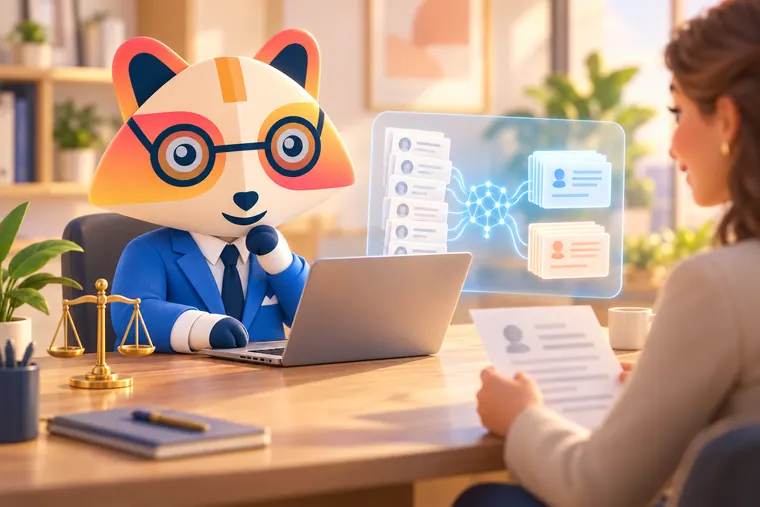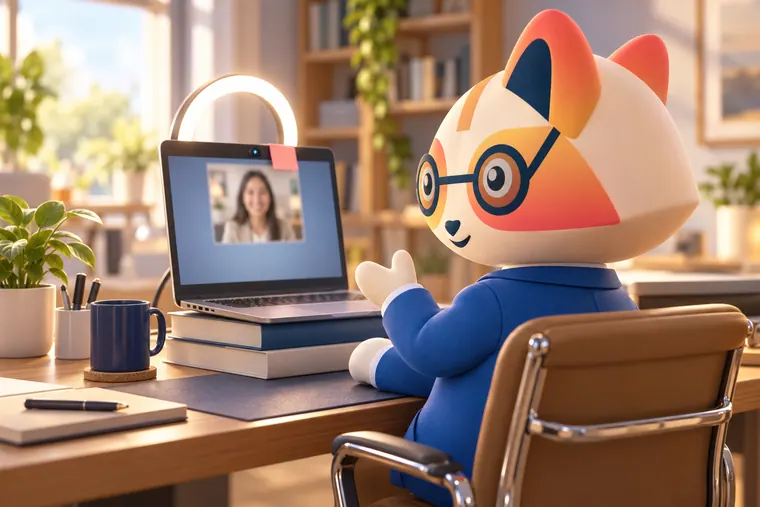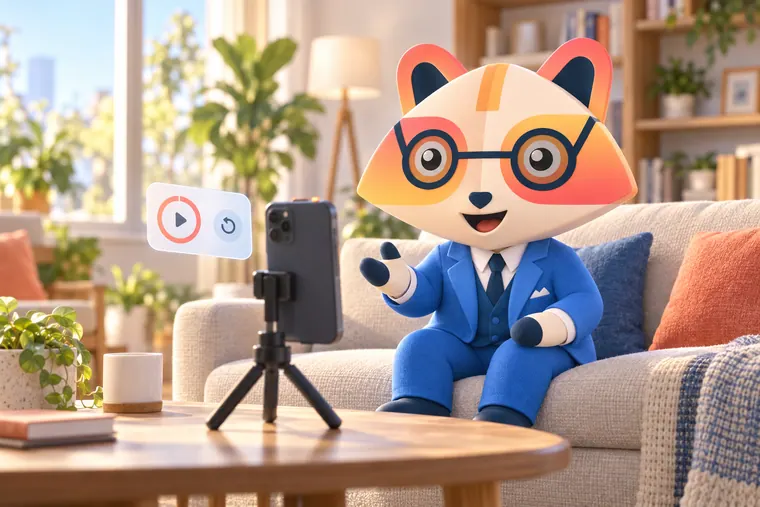

The short answer: an AI interview is a job interview where software, not a person, asks the questions, records your answers, or both. You’ll usually meet one of three kinds: a one-way recorded video interview scored partly by AI, a chatbot screening by text, or a conversational AI interviewer that talks with you and asks follow-ups. Most of these tools judge what you say: whether you answer the question, with relevant, specific examples. Prepare the same way you would for a human interviewer: research the role, prepare four to six stories, practice answering out loud on camera, and test your setup. Below is how each type works, what the AI evaluates, your rights, and how to prepare.
The three kinds of AI interview
| Type | How it works | What to expect |
|---|---|---|
| One-way video interview | Questions appear on screen; you record answers within time limits | Thinking time, a few minutes per answer, sometimes retakes; AI may score transcripts, people may watch |
| Chatbot screening | A text chat asks about availability, eligibility and basic qualifications | Short, factual answers; often schedules the next interview |
| Conversational AI interviewer | An AI voice or avatar asks questions and follow-ups in real time | Feels like a call or video call; adapts to your answers |
For one-way video platforms in particular, see our guides to HireVue and video interview practice.
What the AI evaluates
It varies by vendor, and not every vendor publishes how its tools work. The best-documented example is HireVue, whose 2025 Explainability Statement says its AI transcribes your answer and scores the content against job-related competencies, and does not assess “facial expressions, body language, their background and surroundings, or tone-of-voice.” See our guide to how AI video interviews are scored.
In practice, focus on:
- Answering the actual question, in your first sentence.
- Relevant, specific examples with your own actions and results.
- Clear structure, such as the STAR method.
- The skills in the job posting, shown through examples rather than repeated keywords.
- Clear speech, so transcription is accurate.
Your rights
| Where | What applies |
|---|---|
| Illinois | The Artificial Intelligence Video Interview Act requires employers to tell you AI may analyze your video interview, explain how it works, get your consent, and delete your video within 30 days if you ask. |
| New York City | Local Law 144 requires bias audits of automated employment decision tools and notice to candidates. |
| European Union | The AI Act bans AI that infers emotions in the workplace, except for medical or safety reasons. |
If you need an accommodation for a disability, ask the employer before the interview. Some vendors also offer an option to opt out of AI scoring.
How candidates feel about it
You’re not alone if you’re uneasy. In a Pew Research Center survey of 11,004 U.S. adults in December 2022, 66% said they would not want to apply for a job with an employer that uses AI to help make hiring decisions, and Americans opposed AI making final hiring decisions by a wide margin. At the same time, 47% thought AI would do better than humans at treating all applicants similarly.
How to prepare and pass
- Read the invitation carefully: the platform, the number of questions, time limits, retakes, and the deadline.
- Research the role and pick out the four or five skills the job posting stresses.
- Prepare four to six stories that show those skills, with numbers where possible. See common interview questions.
- Practice answering out loud on camera, within a time limit. Practicing in your head isn’t enough.
- Set up properly: a quiet room, good light on your face, the camera at eye level, a stable connection, and a tested microphone.
- During the interview: use the thinking time to pick your example, answer the question directly, and finish with a result.
- For conversational AI interviewers: treat it like a real conversation. Listen to the full question, ask it to repeat if needed, and answer follow-ups with more detail.
Mistakes to avoid
- Reading a script word for word
- Rambling past the main point to fill the time
- Generic answers with no example
- Using AI to generate answers during the interview: many employers prohibit it, and it can disqualify you
- Leaving it to the last minute before the deadline
Frequently asked questions
What is an AI interview?
How do I pass an AI interview?
Does an AI interview analyze my face?
Is a human involved in AI interviews?
Can I refuse an AI interview?
Sources
- HireVue, 2025 Explainability Statement. Read on 1 October 2026.
- Pew Research Center, AI in Hiring and Evaluating Workers: What Americans Think, 20 April 2023. Read on 1 October 2026.
- Illinois General Assembly, Artificial Intelligence Video Interview Act (820 ILCS 42); NYC Department of Consumer and Worker Protection, Automated Employment Decision Tools; European Commission AI Act Service Desk, Article 5. Read on 1 October 2026.